Showing posts with label Find New Customers. Show all posts

Friday, 28 October 2016

Expanded 7 of 9 Top Tips for Finding New Customers - Get In The News

Get in the news. Try to get coverage in your local paper or trade press. You will need a newsworthy story, or you could put yourself forward as an expert to comment on your industry.

One of the best free publicity you can get which is also the most effective takes time and effort to do.
The below article describes how to get your press released published but the same also applies with getting in the news.

Getting Your Press Release Published


Now that you have your list of media contacts and you understand the press release format, you are ready to
compose your press release and get it published. However it's not always that easy - you may be competing for space with a lot of other stories and every little thing you do can affect how your story is judged. 
If you haven't done so already, read how to write a news story. Then follow the guidelines below to give yourself the best possible chance of being published.

Pick Your Targets

Make sure you submit your press release to the right publications through the correct channels. Don't send your story to publications which have no interest in the topic. Find the most appropriate publications, do your homework and find out the correct way to submit a story.
It's very important in this game to get these things right. You need everything to go smoothly, to the right people in a timely fashion. Think hard about whether you are annoying anyone!

Make the Story Newsworthy

Your story must fit the publishers' criteria of newsworthy. Although this seems obvious, many people optimistically contact the local newspaper every time they think something is news, rather than evaluating the story objectively from the newspapers' point of view. This does your case no good - it will reduce your credibility and chances of being taken seriously when you have a genuine story to offer.
If you are struggling to find a newsworthy angle, look for some central event or happening which you can build a story around. If you want to tell the world how well your business is doing, try to focus on a particular sales target or some other milestone you have reached. Naturally, a special achievement such as winning an award would be an ideal candidate for a press release.
Remember to emphasise the things that are interesting to the publishers' audience, not just the things you want to tell them. For more information see What makes a story newsworthy?

Make the Journalists' Job Easy

Journalists like press releases for the simple fact that they make the journalist's job easier. There is a symbiotic relationship between publicists and journalists and if you're clever you can cultivate this relationship. If you can provide stories which are basically ready to publish, you are doing the journalists a huge favour and they are likely to be receptive.
Any aspect of your press release which requires the journalist to do extra work, such as fixing mistakes or doing additional research, lessens the story's appeal to the journalist.

Use Correct Spelling, Grammar and Case

Be pedantic about spelling, grammar and style. Mistakes will be severely frowned upon. If you can't even run a spell checker, how can you be trusted to provide reliable information in your story? The odd spelling or grammar mistake may not kill your chances, but at the very least you are making the journalist work to fix your errors.
Use the correct mix of upper and lower case. Never, ever compose a press release in ALL UPPER CASE.

More Tips

News Before Introductions
Begin the story with the news headline and main facts. Then, within the first few sentences, introduce the source or main contributors to this particular news item.
Impact First
Make your impact in the first sentence. Don't try to build up to the punch line - make it very clear and simple from the outset.
Think of the Audience
Imagine yourself as a typical reader or viewer watching this story. How is the story relevant to this person? What exactly makes this person interested in the story?

http://www.mediacollege.com/journalism/press-release/get-published.html

Thursday, 27 October 2016

Expanded 6 of 9 Top Tips for Finding New Customers - Advertise on a budget

Advertise on a budget. Should your advertising strategy be improved? Give free advertising on your website to non-competitors who return the compliment. If you pay for advertising, try to negotiate cheaper rates. Pay-per-click advertising online can be targeted and cost-effective.

Paying for advertising can be in two ways - offline and online. Whilst the below article concentrates on online paid advertising which is useful and has some great tips, the additional comment highlighted in yellow throughout this article points out how the suggestions can be used for offline advertising too.

5 Things You Must Do Before Jumping Into Paid Internet Advertising

Paid advertising is a great way to guide more traffic to your site and increase business, but it can become expensive quickly if you aren’t careful. How do you make sure you are getting the most out of your paid ads?
Just the other day, I was speaking with a business owner in my local community. They recently had begun an aggressive Google AdWords campaign that was working, sort of. They were receiving new leads, but the leads were for things they didn’t even do. Their AdWords buy was too broad, and they were paying for leads that weren’t any good.
How do we make sure that our paid advertising is performing as it should be? There are several simple things we can do to make sure we are getting the most bang for our buck.

Understand How Long Tail Keywords Work

The main thing we need to understand before jumping into paid advertising (especially search advertising) is how it all works – more specifically, how keywords work. Google’s AdWords tool is a great resource for discovering keywords in your industry.
The problem with this tool is that it tends to push people toward very broad keywords that are far more expensive and much less effective. These are called “head” keywords. It is important to remember that you aren’t necessarily looking for the highest-traffic keywords. You are looking for the words that your customers use to look for you.
So, you will need to be on the lookout for something called “long tail keywords.” These keywords are the longer, more specific keywords that, when added together, make up the majority of search-driven traffic. 
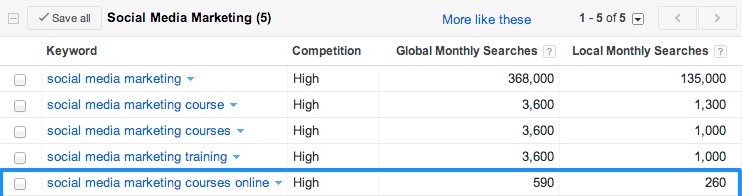
keyword searches
Learn to identify longer, less popular keywords called “long tail keywords.”
In the example above, the term “social media marketing” is considered a “head” keyword, which means it is searched for very frequently. The much less popular term “social media marketing courses online” receives few searches, but better exemplifies a long tail keyword. You might be able to go even further and try something like “the best social media marketing courses online.”
The big mistake that many first-time marketers make with SEO or pay-per-click advertising is choosing the wrong keywords. When you purchase “head” keywords like “social media marketing,” you will spend significantly more money and reduce your ROI dramatically. The key that you have to remember is you will get a lot more bang for your buck by targeting a large number of lower-traffic terms than by targeting a small number of higher-traffic terms.
Finally, the best source of keywords can come from your own website. Consider using a survey tool like Qualaroo to find out what your customers are looking for or why they decided to do business with you (after checkout for example). The language they use can be very effective ad copy for internet advertisements. 
Keywords don't really apply to offline advertising, instead what would be key is understanding your customers and the types of magazines or newspapers the read, where they shop, eat, socialise etc and targeting these places with your advertisements, whether is placing an ad in a magazine, leaflets placed in magazines, postcards/leaflets placed at reception areas etc etc

Know the Territory

There are a lot of places to buy ads, with each site having its own strengths and weaknesses. To start with, you should understand some of the major types of paid advertising.
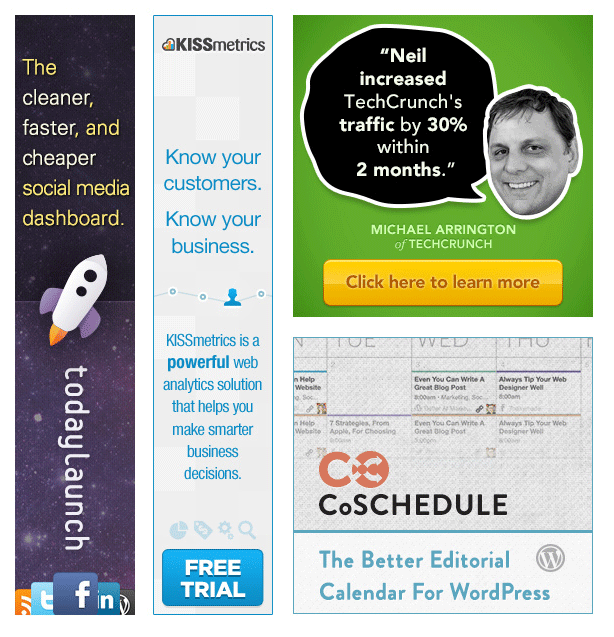
internet ads
Display Ads or Banner Ads – Banner ads immediately come to mind when we think about online advertising because they stand out so noticeably on the page. They are very common and come in a variety of sizes. These ads can be effective, but they tend to target customers who are not actively looking for something new.
For example, a person may be reading a newspaper article and not be interested in a new social media course. Display ads can be successful, but they need to be used properly. Display ads can be purchased using a pay-per-click model or they simply can be displayed for a certain length of time.
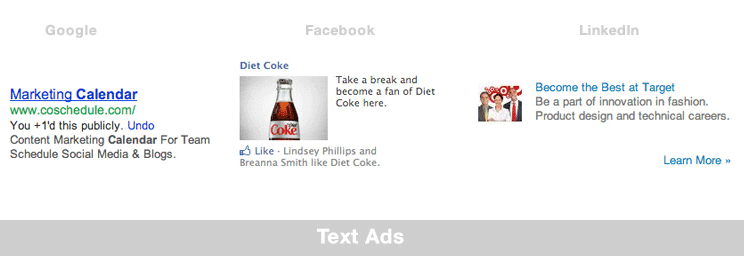
different type of internet ads
Display and banner ads also applies offline, in places like magazines and newspapers. One of the disadvantages is that is is not as targeted as online, but it doesn't mean it will not work for your business either. Marginally more expensive than online advertising, it should not be completely dismissed but maybe something to do a bit later when your marketing budget has increased.
Text Ads – Text ads are the type you usually see on the primary Google search page. These ads generally are less expensive than display ads and target customers that actually are looking for something specific. They can be very effective but depend heavily on good keyword research and A/B testing (a topic we will discuss later in this post).
Here are a few of the places you should try listing your ads, though there certainly are many others:
Google AdWords. – Google AdWords are an obvious choice for many businesses. They offer display and text ads in association with highly targeted keywords. AdWords are a clear choice for any campaign. Bonus Tip: Your Google Adwords ads will produce a better return on investment the longer you use Adwords. Google will rewards long-term customers with better “quality scores”.
Bing or Yahoo. – Bing and Yahoo both offer alternative ad platforms that work similarly to Google’s. They combine display and text ads with targeted search terms. Some brands find that, while these options bring less traffic, the overall ROI is a bit better.
Facebook or LinkedIn. – Social advertising has grown enormously in popularity over the last few years. These ads combine text and display elements and are targeted based on user preferences, demographics, and location. Depending on your business type, both Facebook and LinkedIn are valid options to consider.
StumbleUpon. – The social network StumbleUpon offers a unique paid advertising option that is very inexpensive and guarantees a “click-through” of some kind. This is worth looking into, but it is important to track your actual conversions, which is the primary weakness with this model.
BuySellAds or Direct Buy. – BuySellAds.com is a great place to go to find additional display ad opportunities. These usually allow you to “rent” space on a site or a blog for a fixed cost. Additional opportunities like this can exist if you contact some of your favorite bloggers directly.
In the beginning, it is important to try several of these options and use hard data to make final decisions about where you want to put your money. Often, we simply guess which sites will be best without putting much effort into finding out if we actually are right. Hard data, not guesses, will tell you what gives you the best return. Good tracking capabilities will make this possible.

Have Your Tracking Ready

If you aren’t able to see how each of your ads is performing, then you shouldn’t be buying paid advertising at all. The beautiful thing about online advertising is that you get the opportunity to track everything. Google Analytics is an absolute must when it comes to online ad buying. This analytics package is free and easy to install.
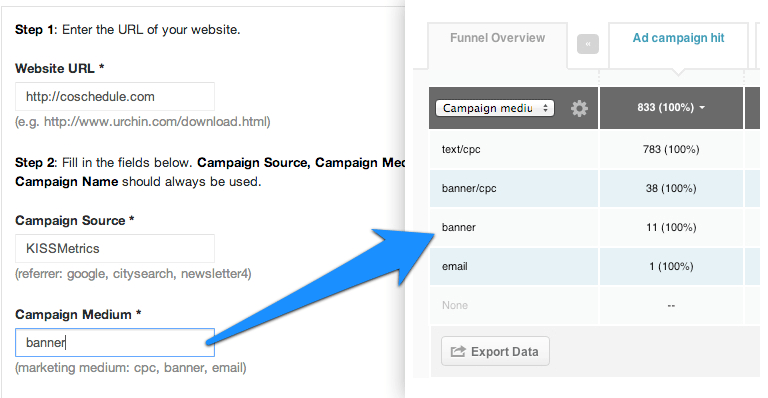
Once you have it set up, you should become very familiar with Google Analytics Custom Campaigns. These options allow you to create a customized URL for each ad that will help you see overall performance for all of your advertising. Using Google Analytics in this way will give you a single dashboard for comparing all of your advertising campaigns. 
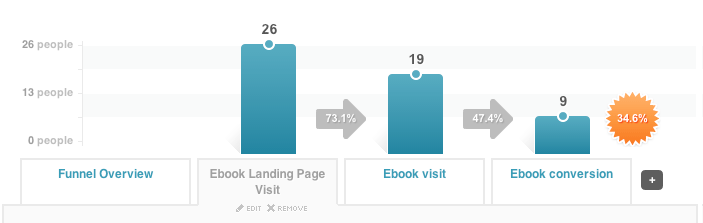
ebook conversion funnel
We can use analytics, like Kissmetrics, to determine how successful our efforts are.
Kissmetrics is another important tool for online tracking because it allows you to create a funnel report for your ads. Not only will you be able to see the amount of traffic that you received from the ad, but you also will be able to see how many of the clicks converted into a genuine lead, a purchase, or even a long-term subscriber.
This type of tracking is extremely important; click and traffic counts simply can’t tell you everything you want to know. While you may get fewer clicks with certain types of ads, if they are more likely to convert to sales, they just might be worth your while. 
utm tracking with KISSmetrics
Google Analytics Custom Campaigns make tracking easy with custom URL tags.
Tracking online is made easier as time progresses. It's a little more 'tricky' with offline advertising. One thing I have tried either through leaflet drops or offline display advertising is changing the name of the contact person, using the infamous 'quote XYZ' to claim this offer etc. I like the name one specifically as I have found my response rates change purely on the name used on the advertising.

Create a Landing Page

It is important to send incoming visitors to a unique page (called a landing page) on your website, rather than your homepage. This may seem counter-intuitive, but there are three very good reasons for using this strategy:
  1. Landing pages allow you to customize your message for incoming visitors. This means that you can continue the message that you started with your ads, which creates a cohesive experience.
  2. These custom landing pages allow you to push visitors toward specific actions, such as downloading a free ebook. (Displaying traditional navigation may distract your visitors.)
  3. Landing pages make tracking your visits very easy. This is especially important.
When you combine this strategy with easy funnel-tracking tools like Kissmetrics, you quickly can gain a lot of information about how to reach and sell to your new visitors. In some cases, you can create a single landing page for an entire ad campaign. In other cases, you may want to create a specific landing page for each keyword that you purchase. 
landing page example
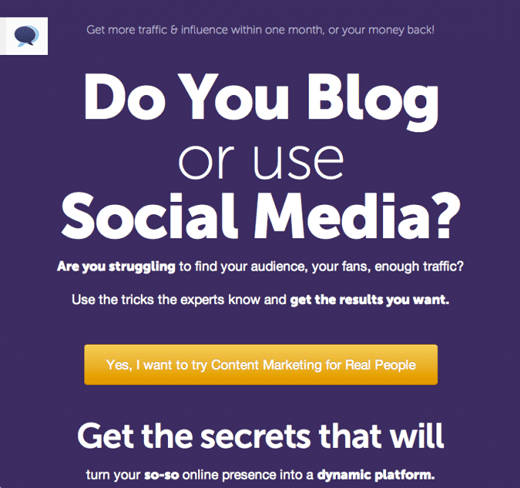
This landing page helps us track who comes to the page and exactly how effective our ads are.
It is important to remember to block your custom landing pages from search engines. This can be done with a simple edit to your “robots.txt” file. This is an important step that will make your ad tracking more reliable. If you allow Google and Bing to send non-paid visitors to your page, you may get a false sense of how your page is performing.
Landing pages can also be used in conjunction with offline advertising, especially if you place a web address on your ad/leaflet designs.
Create a Call to Action – Once you have a visitor on your landing page, how do you convert them into a lead or a customer? Every page you send them to should have a clear call to action. Think about this one carefully, because it’s the difference between a sale and wasted money.
I like to decide what the “number one” desired outcome for each page is before I design a landing page. Simply ask yourself, “What do I want them to do the most?” Then create the page accordingly. 
A good call to action will tell your visitors exactly what you want them to do.
Everything on your page should push your visitors toward the action you want them to take. Without considering this, you’re throwing money away.
Great point but I would just like to add that you can have more than one call to action BUT a landing page should be created of EACH call to action. 
If you advert in the newspaper or online says 'Download a FREE cheat sheet on how to get 100 customers spending $10 on FB Ads'  you will have quick unsubscribes if the download is related to twitter for example. Make sure it's relevant and you deliver what you say you will.
Use A/B Testing – You may have launched your page, but you aren’t done yet. Small tweaks and adjustments can make a huge difference in your overall conversion rate. If you’ve followed the tips above, you should have the proper landing page and conversion tracking to make this task very easy.
A/B testing is being scientific about testing which methods work best. When you go about A/B testing, it is important that you make only a single, testable, change each time. For example, you could test the effectiveness of your page’s headline or button placement, but not both at the same time.
By testing a single change, you will be able to see conclusive results about what works best. A/B testing is an ongoing process, too, so don’t stop. Keep testing and modifying your page. You might be surprised at what it does to your overall conversion rate.
A/B split testing is a quick tool for seeing what works and what doesn't. The same principle applies to offline and this goes back to my suggestion of doing something like changing the name of the contact person on the ad.

Review Results Regularly

Whatever you do, don’t look at your results every day. This practice can lead to off-hand changes that are made too hastily. It is best to wait so that your analytics have time to accumulate accurate trends and information. Then determine a set time period for reviewing your statistics and making changes. It might be monthly, it might be weekly. Checking monthly is a good plan for picking up broad shifts.
Also, you might consider setting up spreadsheets to track your statistics. It’s easier to pick up on trends and understand what you’re seeing when you dig into your analytics to pull out the numbers for your spreadsheet. 
tracking metrics
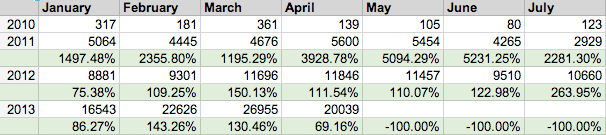
Use simple spreadsheets to track your incoming ad traffic.
Be prepared to kill keywords that are under-performing. Remember, conversion rates are your most important statistics, not clicks. Clicks just waste money unless they are doing something purposeful for you. With all paid advertising, especially AdWords, the longer you run your ads, the better your rates and quality score will become. This will be true particularly if you rely heavily on good A/B testing and are constantly refining your ad buy.

Set a Budget and Plan for the Long Haul

This is something that you will do for a while. Don’t expect to be finished in a week or two. You need to give it time and finesse your plan to get the best results. Again, cumulative trends and information will give you a clearer picture. Dedicate your time and funds for a serious study. Online advertising isn’t a quick-fix solution, but rather one requiring patience and observation.
About the Author: Garrett Moon is a founder at Todaymade a web development and content marketing company, and the makers of CoSchedule an editorial calendar for WordPress that makes content marketing and social media easy.

Wednesday, 26 October 2016

Expanded 5 of 9 Top Tips for Finding New Customers - Back to Basics

Go back to basics. Put up flyers up in local shops. Distribute leaflets and provide introductory offers. A direct mail campaign or an email marketing campaign can also be an effective way to reach new prospects; be sure to observe data protection rules if you go down this path.

Getting Back to Basics are a great way to start and the best thing now is it is not as expensive to do these things as they were 10-15 years ago. I use the term 'expensive' quite loosely as it may not apply to all the below marketing strategies but previously when ordering marketing materials you had to buy in bulk with minimum orders of 500-1000 in the majority of cases.

The following article covers effective offline marketing ideas that are still very much effectively is used correctly - I have provided some additional comments and suggestions in each section to expand a little further for you.


Most of us believe that these days, digital marketing is the only way to get results. While this may be true for a specific target market, some of the best marketing ideas happen offline. The best marketing strategies are those that combine both online and offline ideas seamlessly, in one complete package.
If you haven’t been putting much effort into your offline marketing tactics, then it’s time that you give your start-up a boost with the following tips. Inspiration has always been within your reach, you just need to know where to look.

1. Get creative with your business cards

Investing in well made business cards is one of the most effective ways to get your business out there. Set your brand apart by choosing a unique design that reflects your brand values and creativity. Always ensure that everyone who is anyone in your company has their own to give away, because you never know when they’ll need to share your business details with a prospective client.
Quick tips to make your business cards stand out:
  • Use colored cardboard instead of the usual white
  • Change the orientation from landscape to portrait
Business cards are great for networking......when I say networking I am talking about general day to day conversations you have with your target market or attending events related to your niche or where you would find your ideal customer.

Whilst business cards are important, the quality of your business cards are equally important also. Some cheaper printing companies offer templates, however, there is nothing worse than receiving a business card that is identical to someone else (only with the details changed) trust me this has happened.


I am a fan off business cards printed by Moo.com the paper quality is amazing which in itself stands out and the designs are different and unique also - it's even better if you can get business cards designed specifically for your business and have them printed.

2. Make the most out of your printed marketing material

Another way to get your brand message out to your target market is to give away printed marketing material. Flyer printing may seem like an old tactic, but that doesn’t mean it doesn’t get results. Go the extra mile and innovate beyond the standard template. There are a lot of creative ways you can get your target market’s attention using flyers and pamphlets, so make sure yours are practical for reading, keeping, and saving.
Quick tips to make flyers and pamphlets worth keeping:
  • Print out informative infographics and turn those into flyers
  • Add discount coupons at the bottom of your flyers
There is such a massive range of 'printing material' available now it is sometimes easy to get lost in all of it. 

This article is spot on in what it's saying about innovating beyond standard templates but this in itself is a topic I will cover later for you. For now is a a quick break down on the types and expense level (including design costs)


Brochures - $$$$$

These can be things like booklets of any size or shape or the folders with information sheets/leaflets in it. These take slightly longer to design and will cost a little extra to print also. The folders style of marketing material is great if you need to tailor specific information to different clients and you can pick and choose what goes in there.

Leaflets - $$$

Leaflet design and printing can be quite simple but you will usually find this old school way of canvassing will need large quantities i.e. 500 plus as it can be quite difficult to target with this form of marketing, although still very effective depending on the business.

Letters/Postcards - $$

Postcards and letters are a little more personal if sent by post, however, rather than staying at home printing letters, stuffing envelopes and licking stamps, try using a fulfilment company instead as this sometimes works out cheaper than the stamp itself have a look at www.stannp.com as a great example.

Alternatively rather than posting postcards, you could always hand these out to people that we within your demographic i.e. on a Saturday whilst people are shopping in a busy mall/town centre.

3. Go big with billboards

Go for innovative design if you want your billboards to stand out. There’s so much you can do with outdoor advertising, especially if your billboards are located in high traffic areas. It may seem like a big expense since billboard space doesn’t necessarily come cheap, but the exposure is worth it. Make sure your call to action and contact information is printed clearly to make the most out of your small investment.
Quick tips to save money on billboards:
  • Have your vehicles wrapped and turn them into mobile billboards
  • Partner up with a vertical business for a joint campaign and share the costs for a premium billboard
I especially like the mobile billboard idea, but if you don't have a car or drive and think static bill boards are too expensive (which they generally can be) but mobile bill boards are slightly cheaper, why not ask a friend or family member if you can wrap their car or place stickers in their windows - NOTE! Use cars that moves around a fair bit in your target area, there is no point placing signs in cars that stay on the drive 5 days of the week.

If friends and family are not keen, why not ask tradesman/businesses that compliment your service instead. i.e. if you're a solicitor/lawyer you could approach an estate agent to see whether you can place your branding on their cars. They would expect something in return so you could offer to include their branding in the design if you are wrapping the whole car or contribute towards their fuel costs each month, may be an alternative suggestion.


4. Package your products differently
If you’re selling physical goods with a lot of competition, you need to make sure that your product packaging is well thought out. There are many ways you can boost your brand’s exposure on the shelves just by packaging your products differently. You can also give away stickers or branded knick knacks with every purchase of your product so that fans of your brand can help spread the word.
Quick tips to update your product packaging:
  • Incorporate recycled material into your packaging
  • Change the orientation from landscape to portrait
I have to admit I never through packaging made a massive difference however, I have fallen for this many a time as a consumer. It does matter and well thought out packaging and design is the difference between double digit sales and selling items in the 0000s

Here is a prime example, if you go into your generic computer store and buy a PC, you will usually find your purchase consists of a brown  card board box with some black writing on the front. However, if you purchase an Apple product you receive your item packaged in a white box, nicely designed with a lovely picture on the front - which one would you prefer to buy or most importantly, which one do you 'think' gets the most sales.

NOTE as of today Apple share prices are almost double that of Microsoft!

5. Offer group specific discounts

There’s no better way to foster brand loyalty and get your message out there than by throwing a sale. By offering discounts to a specific target market, you’re making clients feel privileged, while boosting leads and sales. Advertise the incentives and you’ll even get the attention of prospective clients who have never heard of you before.
Quick tips to give away great discounts:
  • Offer unique discounts for every appropriate holiday in your calendar
  • Pick out a specific demographic (freshmen, moms, newlyweds) and give them their own sale week  
This is a great way of boosting sales, a friend of mine has a lodge that she rents out per night. On the occasional weekend she has free or has a last minute cancellation she will also offer a last minute discount to those who book the specific dates.
She just has a small business but you see companies like groupon, last minute.com etc all offering similar incentives to buy.

6. Celebrate holidays with your clients

Love the holidays? Send out cards and small gifts to clients and use special occasions and milestones to make your presence known. And you don’t have to spend a lot of money celebrating with your customers. A well designed, well thought out personalized greeting or small token can show clients that you care and that they mean something to your brand.
Quick tips to make the holidays memorable for clients:
  • Send out “Happy Anniversary” cards with special discounts to your clients on your store anniversary
  • A few months before Christmas, give away a coupon book that your clients can use for their Christmas shopping at your store
This is such a simple idea that seems to have been forgotten and the most important thing I love about this idea, is it shows you care. Christmas and Easter are generic holidays, but I am a member of one brand that sends me a birthday card every year, ok it is printed generically but when they give me a £5 voucher to spend as a 'gift' I am guaranteed to spend more than £5 in store or online.

Once I was actually 'looking' for things to buy because I received a £5 voucher for a minimum spend of £30 and the item I wanted was much less than the £30 - craziness - but it worked.....come to think about it I don't even think it was my birthday but they did send me a random voucher.

7. Get your own PR team

There’s really no need to put together an in-house PR team for your company; you just need to create relationships with relevant media to get favorable coverage from the local journalists in your area. Go out of your way to get to know them and show them what your brand is about. Get your brand story ready and make sure that it’s newsworthy.
Quick tips to get extra PR power:
  • Invite the press over for an official meet and greet
  • Check online for influential bloggers and send over some products that they can review
Getting close to journalists can be quite difficult, but if you build up over time this is great. So if you work within the property/real estate sector you would send an email/comment to journalists that cover this area and always note down your experience, your business and that you are available for comment at any time.

This works best when you comment on something that has happened in the media and I mean that day because tomorrow would be too late. If a journalist asks you to comment they might just include your website address in the paper also which is great free publicity.

8. Network your way to success

Even with a small business, you can network your way to success. There are countless opportunities to build a business network even in a small town, so make sure that you attend all relevant business activities in your area. Check your listings for local business groups that you can join and actively participate in.
Quick tips to create a strong business network:
  • If your area still doesn’t have a business group, round up some interested business owners and meet up to start a small network
  • Create strategic partnerships with non-competing businesses in your area
Great suggestions and don't forget your marketing material as per item #1 in this article.

9. Participate in trade shows

Attending and participating in trade shows is another way to get more exposure for your business. Whether you’re displaying or selling, you’ll be able to generate quality leads in just a few short days. Make sure that your promotional materials are well suited to your objectives so that you don’t waste valuable time or resources.
Quick tips to make the most out of trade shows:
  • Have a gimmick so that your target market will flock to your booth
  • Give away free product samples or discount codes for every lead you collect
This is a great idea for a business that is already up and running, it may be a bit more costly for new business starting on tighter budget. My sister was selling lockets that could hold various charms and it was a great idea as a gift for bridesmaids so we setup a stand at a local wedding show which was inexpensive and I think cost about £45 for the stand so we just presented everything nicely on the table. There wasn't any need for massive banners or anything but it is worth shopping around.

10. Offer expert advice

As an expert in your chosen field, there are numerous opportunities where you can help people and at the same time get airtime for your business. Try becoming a guest at a local radio show or morning TV show and offer consumer advice that is related to your brand and industry. The trick is to sell an idea or product to your market, without the hard sell.
Quick tips to be the expert:
  • Hold a “free consultation” day at your business
  • Have a section for useful tips on your flyers

Now, you’re ready to take your marketing offline and into the world. Which is your favorite offline marketing strategy?
There are a couple of ways of doing this, you could pay for an advertisement on the radio or if something locally has occurred i.e. like some shocking news that you can provide a service to protect people from the same thing happening to them.....call the radio station up and email them and send a short and sweet note saying how you feel about recent events they had reported and how you can help them - is certainly one way of getting your foot through the door.

http://articles.bplans.com/10-effective-offline-marketing-ideas-for-startups-in-2015/

Tuesday, 25 October 2016

Expanded 4 of 9 Top Tips to Finding New Customers - Set Targets

Set targets. To judge how successful your new business drive has been you'll need benchmark goals. For example, you might aim to attract enough new customers to increase profit by 10% over 12 months. Keep your targets realistic.

"Setting Goals or Targets may seem like a simple task but many people (in life) and companies or individuals (in business) either don't or believe the goals and objectives are in their head.

Many of the personal development gurus will always recommend that you write your targets down, more so to refer to them repeatedly in order to stay on track but to assist you with 'seeing' the end target.
Marketing Targets I believe are no different and if you are working with a team of people how are your staff going to be able to help obtain the targets if they don't know what they are??

The following article provides simple steps to setting marketing targets and is a great place to start for any new business"

This Is How You Come Up With Marketing Goals

In Guerrilla Marketing in 30 Days, the late founder of guerrilla marketing, Jay Conrad Levinson, and guerrilla marketing expert, Al Lautenslager offer a dynamic marketing blueprint to help business owners attract more customers and maximize profits. In this edited excerpt, the authors explain how you can set realistic marketing goals that will help you achieve business success.
If you don't know where you're going, how do you know when you get there? This same question can be asked about guerrilla marketing and, more specifically, your marketing. How do you know how effective your marketing is if you don't know what you want it to accomplish?
What are your marketing goals? Your marketing goals are nothing more than a statement of what results you want to achieve with your marketing. What's the primary reason you are marketing?
Marketing goals should fit into and support your overall business goals. Just like any other goal, marketing goals should be measurable. Goals must be specific and realistic as well.
Your goals are the building blocks of your marketing plan, the starting point of the plan. The first component of the guerrilla marketing attack is envisioning the goals--having a crystal clear vision of what will be accomplished during the current year and each subsequent year, with great attention to detail. As an example, Disney's goal is to make people happy. This is the mission guiding all of its business and marketing activity. It's a clear vision, and it's measured along the way. When there's a question about the relevance of a particular activity, it's always reconciled to that crystal clear, overall goal of making people happy.
In creating your marketing plan, you force yourself to focus on the specific goals you want your marketing to achieve for you and on the outcome. The marketing plan also states actions to achieve those goals.
A marketing goal can be a big number, such as a certain year-end revenue figure. It might be a smaller number over a shorter period of time, such as four new clients per month. Goals, although specific and measurable, can be a simple statement of a company's culture or attitude: to be number one in customer satisfaction in a particular industry.
Marketing goals can also be quantitative translations that fit with your company's financial objectives, stated in marketing terms such as to increase:
  • Sales dollars
  • Units sold
  • Market share
  • Mix of products or services
  • ROI on advertising expenditures
  • Awareness
  • Public relations placements
  • Number of new accounts/relationships
  • Share of customer's business
  • Sales conversion rates
You might read this list and think that all these goals apply to your marketing and your business and that they'll all become your goals and part of your plan. Although this attitude is valiant, it may not be realistic. Even though the assortment is broad, true guerrilla marketers don't burden themselves with too many goals.
The right number of goals is the one that offers you a reasonably (with some stretch) high probability of success over a given period of time. "Reasonably," "period of time" and "success" all have to be defined by you and be consistent with your overall business goals and management commitment.
Not only must the number of goals be realistic but so must the actual goals. Setting realistic marketing goals contributes to your marketing success. Making goals too easy isn't realistic. Easy goals require no stretch. Stretching yourself will produce the best results. But setting goals that are unreasonably high will cause you to become frustrated, discouraged and defeated.
Here's a quick checklist of questions to give your goals a reality check:
  • Can I really and truly do this?
  • Have I come close before with similar efforts?
  • Do the numbers, time frame, and dollars seem somewhat practical?
  • Has my competition or have other companies done similar things?
  • Am I avoiding the attitude/mindset that says, "There is no way possible this can be accomplished"?
If you answered yes to the questions above, then your goals are realistic.
The biggest reality test is whether your goals are credible. Do you believe in your goals? Believability is what motivates you toward accomplishment. We're not talking about whether others believe your goals are possible but whether you do. You're the one who must believe because it's you who must be motivated to complete them.
Your marketing goals should be recorded. This allows for tracking, evaluating, measuring and managing. There's nothing better than scratching an item off a to-do list. The completion of simpler goals is the foundation of loftier, more challenging goals.  Inherently, your goal list will have a mix of the two goals.

Prioritizing Goals

When people think of prioritization, they usually think of "What's most important?" or "What will give me the greatest return in the shortest amount of time?" While this is a good approach, you'll invariably run into situations where two goals are of equal importance. So how do you prioritize these goals?
Prioritization relates to focus. Which goal will you work on next? Which goal will get resources allocated to it? Just because you do one before the other doesn't always mean it's more important. Focus on completion as well as importance.
This doesn't imply that you should work on goals one at a time. In today's fast-paced environment, multitasking is the name of the game. Managing multiple goals and activities simultaneously can be done, directing focus and resources as situations change and progress.

Monday, 24 October 2016

Expanded 3 of 9 Top Tips for Finding New Customers - Freshen Up Your Image

Freshen up your image. Is your signage or business logo looking tired? Does your website need revamping? Is your online marketing strategy working? Could it be time to rebrand or even rename your business?

"If you're starting as a new business it may not be necessary to 'freshen up' however, from experience and guidance from previous experts, third parties etc even new business may need to freshen up.

If you have a website then you are likely to be selling or offering something online. Whilst the website looks great it may not be geared up for easy usage or for use for online marketing and is more of a brochure than a means of earning money online.

Having a clear goal of what you want a website to do is essential and the following article provides some great guidance regarding this."


HOW TO REBRAND: 19 QUESTIONS TO ASK BEFORE YOU START


Companies will at some point come to that milestone known as “the rebrand.” For some, it happens early on once they’ve discovered who they really are while with others, it occurs after many years of having grown (or outgrown) their brand.

THEN AND NOW

You’ll discover that some brands go along an evolutionary track that one could basically follow. (Personally, I am not a fan of the current Pepsi logo and consider the legacy and heritage was tossed out the window with the current logo, whereas Coca-Cola has done an amazing job of maintaining and refreshing their brand.)


Others have made a change that was a disastrous departure that resulted in a complete about-face within a two-week window:

And while a brand is so much more than a company’s logo, the logo is one of the key ambassadors to any brand. Hence the examples shown above. (To see the 5 types of rebrands, click here.)
There are various reasons, assorted catalysts or numerous “straws that can break the camel’s back” of the old or existing brand.
Yet, there are a number of questions that routinely come up when I start with a company to rebrand them. Here (in no particular order) are many of the questions that need to be answered to keep the brand:
  • true to itself,
  • meaningful so people take notice and care, and
  • powerful enough to make the difference everyone hopes for.

19 QUESTIONS THAT EVERY REBRAND NEEDS TO ASK

  1. Why are we doing a rebrand?
  2. What problem are we attempting to solve?
  3. Has there been a change in the competitive landscape that is impacting our growth potential?
  4. Has our customer profile changed?
  5. Are we pigeonholed as something that we (and our customers) have outgrown?
  6. Does our brand tell the wrong (or outdated) story?
  7. What do we want to convey? To whom?
  8. Why should anyone care about our brand?
  9. Have we isolated exactly who should care about our brand?
  10. Have their needs, or the way they define them, changed?
  11. Are we asking our customer to care more about our brand — and what it means — than we do?
  12. Is our brand associated with something that is no longer meaningful?
  13. Is our brand out of step with the current needs and desires of our customers?
  14. Are we leading with our brand direction?
  15. Are we following with our brand direction?
  16. Is the goal of this rebrand a stepping stone (evolutionary) or a milestone (revolutionary) ?
  17. Will this solution work in 5, 10 and 15 years from now based on what we can anticipate?
  18. Have we assigned some committee to manage the project versus someone (or at most, two people) who is/are focused, inspired and can lead?
  19. If we were starting our business today, would this be the brand solution we would come up with?

MORE THAN SKIN DEEP

Use the questions above to isolate why you rebrand and how to keep your rebrand from the “cliffs of insanity” (i.e., cliche crud like much of the current wave of homogenized, committee-drenched crap being put out by several of the big Fortune 100 corporations over the last few years). And remember, a lot of this has to do with exceeding expectations, something discussed by the top 23 most influential leaders in business today.

http://www.risingabovethenoise.com/how-to-rebrand-19-questions-ask-before-you-start/